


Best Laminates for Commercial Spaces: Offices, Hotels & Malls
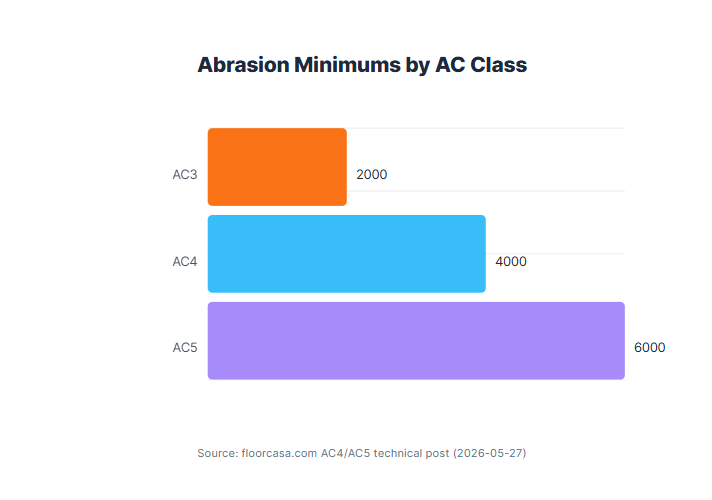
A commercial floor that passed its AC rating on the box can still swell at the cut joints or deform under a loaded pallet jack, because the wear rating and the moisture path are two different specifications. EN 13329 abrasion testing sets AC4 at a 4,000-cycle minimum and AC5 at 6,000, yet the AC rating measures abrasion only: it says nothing about water or vapour resistance, so a high AC grade can sit on a core that fails the moment cleaning water reaches an exposed edge. Getting that wrong costs a replacement cycle, not a repair: lift the failed planks, re-prepare the subfloor, re-lay, and close the space again. This guide sets out how to specify the best laminates for commercial spaces by treating offices, hotels and malls as three different technical problems, each with its own governing number and its own red flags, so you can compare bidders on criteria rather than on a box label.
This guide is published by Deliya Flooring, a manufacturer of waterproof laminate, SPC and tile flooring based in Changzhou, China, operating from a 50,000-square-meter facility. Deliya produces its own high-density fiberboard and decorative papers and runs in-house high-pressure lamination lines and a quality control laboratory, which is the part of its work that relates to laminate performance in commercial settings. The company supplies wholesalers, distributors, retailers, brand owners and construction contractors in more than 40 countries.
How to Specify the Best Laminates for Commercial Spaces
The best laminates for commercial spaces are the ones whose class code matches the room, not the ones with the highest number on the box. Four criteria decide that match, and every supplier quote you receive can be tested against them.
Use class comes from EN ISO 10874, the level-of-use classification that EN 13329, the European laminate product standard, refers to for its requirements and test methods. Class 32 covers offices, waiting areas, hotel lobbies and stores; classes 33 and 34 cover hallways, large offices, shopping malls and classrooms, according to the reported EPLF mapping.
Wear class is the AC grade, measured in Taber cycles under EN 13329: class 32 starts at 4,000 cycles and class 33 at 6,000. Published AC4 ranges run 2,500 to 4,000 cycles, typically 3,000 to 3,500, while AC5 spans 4,000 to 6,000, with premium grades reaching 8,000 to 10,000 (floorcasa.com). AC5 is mapped to heavy commercial and public spaces; AC4 to heavy residential and moderate commercial use.
Construction covers core density, thickness and edge treatment. Moisture path covers how water reaches the core and how it leaves.
Warning: The AC rating measures abrasion only. It says nothing about water or vapour resistance, so a high AC grade can coexist with modest water resistance.
Needs Assessment: What Your Building Actually Requires
Five inputs decide which commercial laminate flooring specification fits your building: traffic volume and type, subfloor construction and moisture condition, cleaning regime and chemicals, acoustic separation, and expected service life before refurbishment. Get these wrong and the rest of the specification is guesswork.
Traffic type matters more than raw footfall. A hotel corridor takes millions of light footfalls; a mall service route takes fewer passes but concentrated rolling loads and castors. Those two floors need different cores and different wear layers.
Moisture is two separate problems. Surface water from cleaning and spills is handled by the wear surface and edge sealing, while subfloor vapour rising through a slab is a different mechanism that needs a barrier under the floor, as Wally's Carpet sets out in its guidance on moisture barriers. Treating one as the other is a common and expensive error.
Acoustic separation is the input buyers most often leave until too late. Acoustic underlayments are rated in the range of 17 to 19 dB of impact sound reduction, with laminate and quality underlayment combinations reducing impact sound by roughly 8 to 20 dB, according to Trimaco's dB4 Max product data (2025). Since 10 dB is roughly a halving of perceived loudness, that range decides whether an upper-floor hotel room is sellable.
Input | Offices | Hotels | Malls and retail |
|---|---|---|---|
Traffic volume and type | Footfall plus castor chairs | Continuous light footfall, trolleys | High footfall, pallet trucks, castors |
Subfloor and moisture | Raised floors, screed, slab vapour | Wet rooms, slab vapour, older substrates | Large slabs, ground-floor vapour |
Cleaning regime | Dry and damp mopping | Frequent wet cleaning, disinfectants | Machine scrubbing, chemicals |
Acoustic separation | Between meeting rooms | Between guest rooms, critical | Open-plan, less critical |
Service life before refurbishment | 7 to 10 years | 5 to 8 years, refurbishment cycles | 10 to 15 years |
Write the five answers down before you look at a single product. They become the requirement column your bidders are measured against.
Offices: Traffic, Rolling Loads and Castor Chair Resistance
An office floor is specified on wear class and castor-chair performance, not on appearance, which is why AC4 vs AC5 laminate for offices is the first decision rather than a finish sample. The EN 13329 abrasion test sets the class 32 floor at 4,000 cycles, while class 33 requires 6,000 or more. Practical AC4 ranges sit between 2,500 and 4,000 cycles, with AC5 running 4,000 to 6,000 and premium constructions higher.
Wear class alone does not cover a chair. Castor-chair resistance is tested under ISO 24338 / EN 425, which rolls loaded castors over the floor and judges whether the wear surface and joints stay visually and functionally intact (ISO 24343-2). No pass or fail number is published for that method here, so the specification should name the test rather than quote a figure.
The reported EPLF mapping places class 32 in offices and waiting areas, with classes 33 and 34 covering large offices. Treat that as reported rather than verified. Class 32 is the floor; class 33 is the safer specification wherever chairs roll continuously.
Hotels: Moisture, Cleaning Regimes and Acoustic Separation
Hotel flooring fails from above and from below, and the AC rating covers neither. Spills, housekeeping trolleys and aggressive cleaning attack the surface; vapour migrating from a concrete subfloor attacks the core; and footfall on the floor above travels through the assembly as impact noise. For laminate flooring for hotels and malls, the specification has to separate surface-water resistance from subfloor vapour control, because they are different mechanisms with different fixes. A surface seal or waxed edge resists liquid sitting on the plank; it does nothing about moisture rising through the slab, which is managed at the subfloor with a vapour barrier or membrane. Treating one as the other is how a floor that tested well in the showroom swells in service.
Acoustics is the second hotel-specific criterion, and it is an assembly property rather than a plank property. Wally's Carpet reports that quality underlayment reduces impact sound by roughly 8 to 20 dB, with laminate-and-underlay builds rated around 17 to 19 dB ΔLw, where a 10 dB change is heard as roughly halving perceived loudness. Treat those as vendor-claimed ranges, not independent test results, and ask each bidder for the ΔLw of the exact plank, underlay and substrate combination they propose.
Warning: A wax-sealed edge is not a waterproof system. They are separate claims, tested separately, and should be specified as separate line items in the bid.
Thickness swell is where bids quietly diverge. A commercial thickness-swell threshold is typically specified around 16% under NALFA-type criteria, but there is no single universal figure: the specifier must state one exact threshold and one exact test method, applied to every bidder, or the numbers returned will not be comparable. Note that this is a project specification choice, not an EN 13329 requirement.
Malls and Retail: Continuous Abrasion, Impact and Cleaning Chemicals
Mall specification is driven by wear class 33 and above, plus impact and indentation performance, because a mall floor faces continuous abrasion across large uninterrupted areas, trolley traffic and repeated chemical cleaning. Class 33 starts at 6,000 Taber cycles under EN 13329, and the reported EPLF mapping places classes 33 and 34 in shopping malls and large offices, which is why a class 32 board sold for offices is the wrong starting point here. Premium AC5 grades are published up to 8,000–10,000 cycles, so the cycle count, not the AC label alone, is what separates bids.
Impact is the second governing test, and it is where mall bids are usually thinnest. Residual indentation, measured under ISO 24343, is the thickness difference remaining after a load is applied and released. ISO 24343 sets no numeric pass threshold of its own; the limit comes from the manufacturer's or product standard's stated value, so a bid that quotes an indentation figure without naming its limit has not actually specified anything.
Red Flags and Deal-Breakers in a Commercial Laminate Bid
Most bad commercial laminate flooring specification decisions are visible in the bid documents before anyone orders a sample. A quoted AC rating with no named product standard or edition is the first warning: AC classes only mean something against EN 13329, ISO 14486, NALFA LF-01 or GB/T 18102, and a bidder who omits the edition may be quoting a withdrawn test. A thickness-swell figure with no test method is the second. Formaldehyde is the third, and it is the one buyers most often get wrong: the grade attaches to the core panel, not the finished floor, so a supplier's declared panel grade is the specification point to require in writing. The limits themselves are precise. E1 caps chamber emissions at 0.124 mg/m³, with E0 at 0.050 and ENF at 0.025 (NF Woods formaldehyde grades guide, retrieved this run). Note the limit: that page is undated and rests on a single upstream source, so confirm the current edition with the panel supplier.
Red flag | Must-have criterion | Document that proves it |
|---|---|---|
AC rating quoted with no standard or edition | AC class named against EN 13329, ISO 14486, NALFA LF-01 or GB/T 18102 | Test report stating the standard edition |
Thickness-swell percentage with no method | Swell figure tied to a named immersion test | Laboratory test certificate |
Formaldehyde grade quoted for the finished floor | Declared core panel grade with chamber method | Panel declaration, E1/E0/ENF or CARB P2 |
Warranty excluding moisture or commercial use | Warranty covering the specified traffic class | Warranty terms in the bid |
Core density not declared | Published core density in kg/m³ | Technical data sheet |
How to Compare Commercial Laminate Against SPC, LVT and Tile
Commercial laminate vs SPC and LVT comes down to one trade: laminate wins on installed cost and abrasion resistance in dry, high-traffic interiors, and loses wherever standing water, wet cleaning or heavy impact governs the floor.
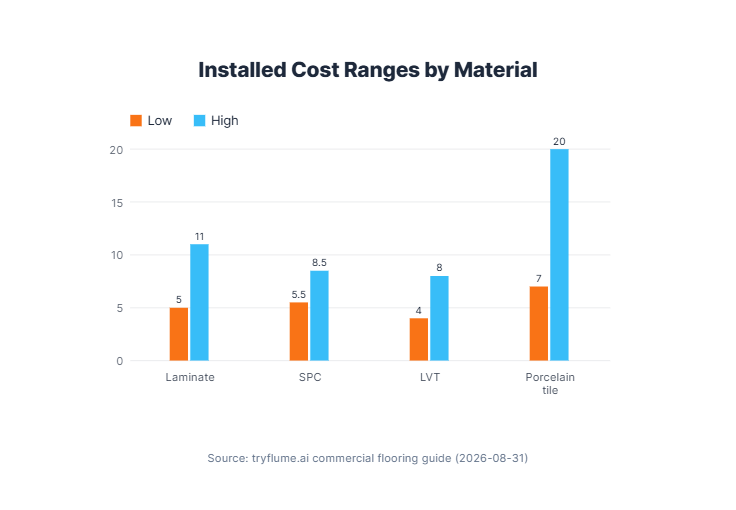
Published commercial cost guides put installed laminate at roughly $5 to $11 per square foot, against $5.50 to $8.50 for SPC, $4 to $8 for LVT and $7 to $20 for porcelain tile (TryFlume flooring guides, retrieved 2026-08-31). Those ranges come from vendor-side cost guides, so treat them as planning bands rather than quotes.
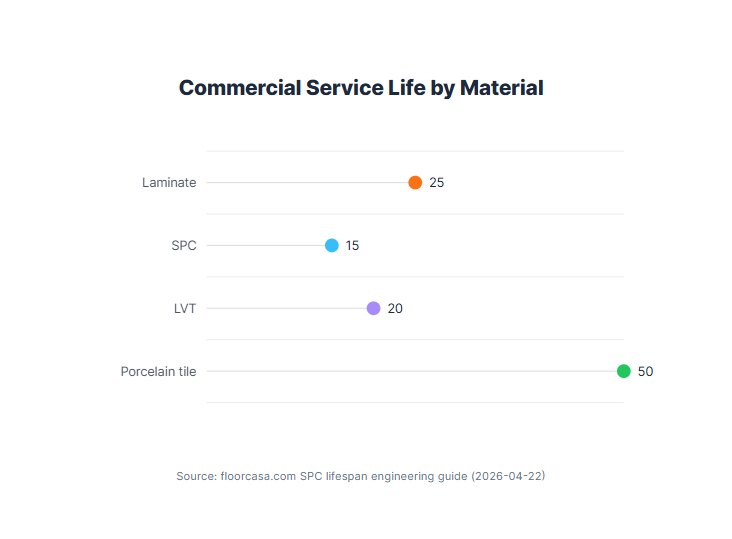
Service life follows the same split. Published ranges put commercial laminate at 12 to 25 years, with AC4 and AC5 grades cited at 15 to 30, SPC at 10 to 15 standard and 20 to 25 premium, LVT at 10 to 20, and porcelain at 25 to 50 or more (Floorcasa SPC lifespan guide, retrieved 2026-04-22). The laminate figure is the least independently tested of the four, so verify it against the supplier's own warranty terms.
SPC's lifespan is driven mainly by wear layer, and 0.5 mm is the commercial floor. A 0.3 mm wear layer specified for a commercial office wears through in 3 to 5 years, while premium SPC carries a 15 to 25 year commercial warranty against 5 to 10 years standard (Floorcasa, retrieved 2026-04-22).
Writing a Commercial Laminate Specification Bidders Can Be Compared On
A commercial laminate flooring specification is comparable only when every bidder answers the same declared test data against the same named standard. If the document says "durable" or "suitable for heavy traffic", each quote will be priced against a different product and the numbers will not mean anything.
Build the clause list so that every line has a unit, a class code, or a named standard attached to it:
Clause | What the bidder must declare |
|---|---|
Product standard | The standard and edition the panel is tested to |
Use class | The class code for the intended environment |
Wear class | AC rating, stated per product |
Thickness and core | Millimetres, plus core density in kg/m³ |
Edge and locking | Edge profile and locking system named |
Moisture protection | The method, not the claim |
Formaldehyde | Grade declared against the core panel |
Acoustics | Performance figure with the underlayment named |
Warranty | Term, plus the exclusions in writing |
One threshold rule prevents most disputes: state a single maximum for thickness swell after water exposure, and reject any bid that reports a different test duration. A supplier can meet a demanding figure on one test and miss it on another, so the duration belongs in the clause.
Deliya's published commercial laminate data illustrates how a criterion gets answered rather than evaded: AC4 and AC5 ratings, 8, 10 and 12 mm thicknesses, an HDF core stated above 880 kg/m³, wax-sealed edges, and E1 with CARB P2 and E0 grades available. That is Deliya's own published data, not an independent benchmark, and a bidder's sheet should be read the same way until a test report backs it.
