


Waterproof Laminate Flooring: B2B Buyer's Spec Guide
Ask five suppliers what "waterproof laminate" means and you will get five different answers. One sends a spec sheet showing a 24-hour thickness swell under 8%. Another says the planks are "aqua-protected" and leaves it there. A third quotes an AC4 rating as if it settles the water question, which it does not — abrasion resistance and moisture resistance are measured by separate tests and tell you nothing about each other.
For a wholesaler holding inventory, a retailer fielding returns, or a contractor signing a callback warranty, that inconsistency is the real risk. Not the price per square meter. The variation.
This guide breaks waterproof laminate flooring into the seven specifications that actually determine performance, tells you what numbers to ask for on each, and shows where suppliers hide weakness behind vocabulary. Where Deliya's construction serves as a reference point, we say so — but every criterion here is written so you can apply it to any supplier's spec sheet, including ours.
What "Waterproof Laminate" Actually Means at the Factory Level
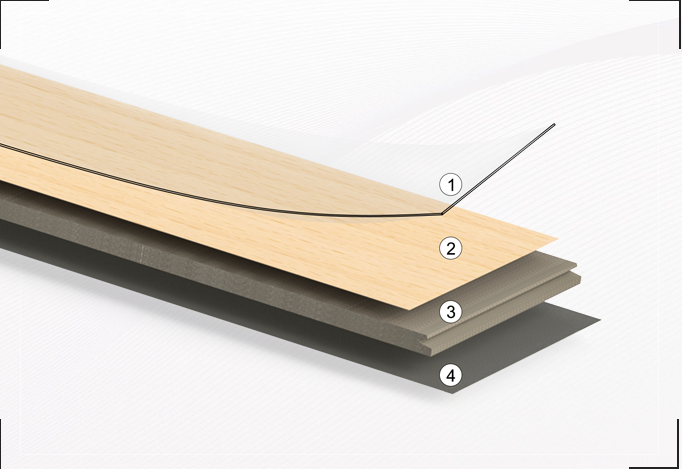
Laminate is a pressed sandwich, not a solid material. A high-density fiberboard (HDF) core sits in the middle, carrying the structural load and the milled click profile on all four edges. Above it: a decorative print layer, then a melamine-impregnated overlay that becomes the wear surface. Below it: a balancing backing layer that offsets the tension of the top layers and keeps the plank flat.
Standard HDF is a wood-based product. Wood fiber plus resin, pressed under heat. That core is dimensionally stable and dense, but it is not inherently immune to water. Exposed edges wick moisture; the fiber swells; swollen fiber does not shrink back. That is the mechanism behind almost every laminate failure claim in the field — not flooding, just prolonged edge contact with standing water and a core that was never treated for it.
So "waterproof laminate" is not a material category. It is a set of engineered countermeasures applied to a wood-based core:
A denser, moisture-managed core — higher density means less void space for water to enter.
A hydrophobic treatment inside the core — wax or a similar additive blended into the fiber-resin matrix, or a treated core board in place of standard HDF.
Sealed edges — the milled click profile is where the core is cut open and most vulnerable.
A tight locking system — a joint that stays closed keeps water on the surface instead of in the seam.
A sealed surface — the melamine overlay and backing layer already resist surface water. This was never the weak point.
Miss any one of these and the claim weakens. A wax-treated core with unsealed edges still swells at the joint. Sealed edges over a low-density core still deform under sustained load. Supplier vetting should therefore be spec-by-spec, not claim-by-claim.
HDF Core Density: The Specification That Sets the Ceiling
If you only audit one number, audit this one. Core density determines dimensional stability, impact resistance, screw-holding capacity, and how well the click profile holds its geometry after machining. It also caps how much good everything downstream can do.
Density is expressed in kilograms per cubic meter (kg/m³). For flooring-grade HDF, general industry guidance puts the practical working floor at roughly 800 kg/m³, with 850 kg/m³ and above preferred for residential applications and 900 kg/m³ and above for high-traffic or commercial settings (DG Floors). Below that range, the core behaves more like MDF — adequate for furniture, not for a floor that will be walked on for fifteen years.
What to ask for:
The density figure, with the test standard. Look for EN 323. A supplier who cannot cite the standard may be quoting a design target rather than a measured result.
Internal bond strength. This measures how well the fiber matrix holds together — low bond strength means the core crumbles at the joint under load. Typically verified under EN 319.
Whether the core is produced in-house or purchased. This matters more than buyers usually assume, and it is covered below.
A note on the in-house question. Many flooring exporters buy HDF panels from third-party board mills and run the lamination, profiling, and packaging themselves. That is a legitimate model, and many of them produce excellent floors. But it means the core spec is inherited rather than controlled — the supplier's density figure is only as stable as their board mill's process, and it can drift between runs without anyone at the flooring plant noticing. A supplier who presses their own HDF can hold density to a tighter band and adjust it per product line. Deliya manufactures its own HDF core board and decorative print paper in Changzhou, which is why we can state density as a controlled process parameter rather than a sourced input. If you are evaluating any supplier, ask where the core board comes from and how often they re-verify it.
AC Rating and Wear Layer: Durability, Not Water Resistance
This is the most common misreading in the category, so it deserves a blunt statement up front: the AC rating tells you nothing about water resistance.
AC ratings (AC1 through AC5) come from the EN 13329 abrasion test. A weighted abrasive wheel grinds across the wear surface for a specified number of cycles, and the plank is graded by how much material it loses. AC3 corresponds to roughly 2,000 cycles, AC4 to roughly 3,500, and AC5 to roughly 5,000 (Beflooring technical data). It is a surface durability metric. Full stop.
What the AC rating actually guides is room placement and traffic class:
Rating | Traffic Class | Typical Application |
|---|---|---|
AC3 | Class 31 | Light residential — bedrooms, low-traffic rooms |
AC4 | Class 32 | General residential to light commercial — living areas, offices, retail floors |
AC5 | Class 33 | Heavy commercial — hotel lobbies, hospitality, high-footfall public space |
For B2B buyers, AC4 is the sensible baseline for a retail assortment intended for mainstream residential use, and AC5 is where commercial and contract projects should land. If you are stocking a single SKU to serve both channels, AC4 sits closer to the volume middle than AC5 does, and the price gap is real.
Where the AC rating and the waterproof story intersect — and the only place they do — is in surface integrity under repeated wet cleaning. A floor that will be mopped frequently needs a wear layer that resists abrasion and chemical cleaning agents, because a compromised surface is the first step toward water reaching the printed layer and the core. Specifications here also reference wear layer thickness, commonly expressed in millimeters rather than mils for laminate (0.1 / 0.2 / 0.3 / 0.5 mm are typical bands), and it is worth knowing which band a supplier's product falls into rather than accepting "commercial grade" as a description.
Thickness and Plank Format: Stability Versus Cost
Waterproof laminate flooring is produced mainly in 8 mm and 12 mm constructions, with some suppliers offering ranges beyond that. Thickness is frequently oversold. A 12 mm plank is not automatically more water-resistant than an 8 mm plank — thickness alone proves nothing about core treatment. What thickness genuinely affects is:
Rigidity and feel underfoot. Thicker planks deflect less and sound more solid, which matters for how the floor sells in a showroom.
Tolerance to subfloor irregularity. A stiffer plank spans minor subfloor variation better, reducing the risk of joint stress and premature wear at the seams.
Impact resistance and acoustic performance. Both improve with thickness.
The trade-off is straightforward: 12 mm costs more per square meter and takes more container volume for the same coverage — a real line-item in freight math, especially on long-haul container loads. For a distributor balancing assortment against landed cost, an 8 mm AC4 build with a properly treated core often outperforms a 12 mm plank with an untreated one, at a lower total landed cost.
Plank format deserves the same scrutiny. Standard waterproof laminate runs around 1218 × 178 mm, with 1218 × 197 mm and longer, wider formats increasingly common as the category moves toward the length and width of real hardwood planks. There is also a structural dimension here worth raising with any supplier: can the width be adjusted, and what are the constraints on length? Dimension flexibility is where a manufacturer's own production control shows itself — a plant that presses, prints, and profiles in-house can adjust width within a band, but length generally has to follow multiples of the base design because it is tied to the decorative paper repeat. A supplier who says "any size you want" without qualification is either reselling or about to disappoint you on the first order.
How Water Resistance Is Engineered: Core, Edges, and Joints
This is the section to bring to your next factory visit. Water resistance in laminate is a chain, and the claim is only as strong as the weakest link.
Core treatment
The core is treated in one of a few ways: a hydrophobic additive blended into the fiber-resin mix during board production, a wax-impregnated core, or a formulated core board designated for wet-area use. Suppliers in this category often use a distinct core color to signal the treatment — Deliya's waterproof aqua floor lines, for example, use an upgraded "Black Core" or "White Core" substrate for kitchen and bathroom applications, which makes the specification visually verifiable at the factory rather than only on paper. That kind of physical marker is useful to buyers precisely because it can be checked at receiving inspection.
Edge sealing
The milled click profile cuts into the core and exposes raw fiber. This is where moisture enters. Edge sealing applies a treatment to that profile — PUR (polyurethane), acrylic, wax, or a proprietary hydrophobic coating. Four-sided waxing and PUR-sealed edges are the common approaches, and the difference is observable on a sample: a waxed edge looks slightly waxy and feels slick; a PUR-sealed edge is harder and more sealed-looking.
Ask for the edge treatment type and the edge swell result, not just the presence of a treatment.
The performance numbers that settle the argument
Two test results do most of the work here:
24-hour edge swell (EN 13329). Industry reporting places PUR-sealed waterproof constructions at approximately ≤6%, against 12–20% for unsealed laminate (Floorcasa engineering comparison). Deliya publishes graded swelling bands for its waterproof lines — standard ≤15–18%, water-repellent ≤12%, extra-durable ≤10%, and ultra-durable ≤5% — which lets a buyer specify the band appropriate to the end application instead of accepting a blanket claim.
24-hour thickness swell (ASTM D1037). Published guidance puts premium waterproof constructions at ≤8%, against 15–25% for untreated laminate. Thickness swell measures the same failure mode from a different angle: how far the plank expands after full immersion.
If a supplier cannot produce either number from a third-party test report, that is your answer. It is not a specification gap you can fix downstream — it is a disclosure gap, and in this category disclosure gaps correlate with performance gaps.
Joint integrity
A tight joint is part of the waterproof system, not a separate installation detail. Better products specify locking systems with sealed or gasketed edges — Deliya uses Unilin click and Unilin drop profiles with wax-sealed edges, and publishes wet tensile strength where available. The metric to request is wet tensile strength: joint strength measured after moisture exposure. A standard tensile figure tells you the joint holds in a dry heated room, which is not the condition you are worried about.
On certification: the credibility markers to look for in this category are ITS, SGS, CE, ISO 9001, and for the US market specifically, CARB Phase 2 and E0/ENF formaldehyde grades. Those last two are non-negotiable for US retail and will be requested by any serious importer.
Installation Systems and the Contractor Reality
Waterproof laminate is a floating floor. It clicks together, sits on an underlayment, and is held in place by its own weight and the perimeter expansion gap — it is not glued down. This is a genuine advantage for contractors: no adhesive cure time, minimal downtime, and a floor that can be walked on immediately. It is also why locking system quality is not a detail.
Profiles you will encounter are Unilin click, Unilin drop, single-click, and angle-and-fold designs. For specification purposes, the distinctions that matter are:
How the joint was tested after soaking. A profile that locks cleanly dry but opens at the seam after a spill is a callback generator.
Whether wax sealing is applied to the profile. The wax film provides the immediate barrier while the mechanical lock provides the geometry.
What the manufacturer specifies for perimeter sealing. This is the piece most often missing from marketing materials and most often responsible for real-world failures. A product marketed for kitchens and bathrooms should state its approved installation conditions explicitly — whether the perimeter requires sealant, whether an underlayment with a built-in vapor barrier is required, and whether the floor is approved over concrete slabs on grade.
An honest underlayment note for your installers: waterproof performance refers to water reaching the floor surface and the joint, not to water vapor rising from a subfloor. Below-grade and on-grade slabs need a vapor barrier underlayment regardless of how good the plank is. Sellers who blur that line are setting up a claim they cannot win — which is why the installation guidance that ships with a product is worth reading before you quote a project, not after.
Where waterproof laminate genuinely performs well in real projects: kitchens, bathrooms, laundry rooms, basements, mudrooms, apartments, hotel corridors, and retail floors where cleaning crews mop aggressively and frequently. Where no floating floor should be sold as a solution: an actively leaking appliance, a failed plumbing line behind a wall, or a chronically damp slab with no mitigation. Setting that expectation with your customers up front is worth more than any warranty clause.
What to Verify Before You Commit to a Supplier
Every criterion below can be checked without a lab. Print it, take it to the factory, and work down the list.
# | Criterion | How to Verify |
|---|---|---|
1 | Core density ≥850 kg/m³ residential, ≥900 kg/m³ commercial | Request EN 323 test report; confirm the core source (in-house vs. purchased) |
2 | Internal bond strength | Request EN 319 data; low bond strength means joint failure under load |
3 | Water-resistant core treatment | Visual confirmation of treated core; ask for the treatment type, not the marketing name |
4 | Edge sealing on all four sides | Take a sample in hand; wax vs. PUR is visible and tactile |
5 | 24-hour edge swell | Request EN 13329 result; ask for a graded band, not a single blanket claim |
6 | 24-hour thickness swell | Request ASTM D1037 result; ≤8% is the premium benchmark |
7 | AC rating appropriate to the channel | AC4 for mainstream retail, AC5 for commercial and contract |
8 | Locking profile with wet tensile data | Unilin or equivalent, with post-soak joint testing |
9 | Formaldehyde grade for US import | CARB Phase 2 at minimum; E0/ENF preferred |
10 | Third-party certification | ITS, SGS, CE, ISO 9001 — request certificate copies with issue dates |
11 | Installation conditions specified in writing | Perimeter sealing, underlayment requirement, slab approval |
12 | MOQ, mix-container, and private-label terms | Confirm per color and per container; clarify label ownership |
Two closing observations from working with buyers in this category.
First, run the sample test yourself. Get three samples from three suppliers, submerge a jointed pair of planks in water for 24 hours, and measure the joint. It is a crude test compared to EN 13329, but it is directionally honest, and it will tell you more in one afternoon than any brochure will in a month.
Second, differentiate your suppliers by stability, not by price alone. In a category where the core, the print paper, and the pressing process determine consistency, vertical integration is not a marketing story — it is a supply-chain risk factor you can price. Deliya has been manufacturing waterproof laminate, SPC, and customized tile from a 50,000 m² facility in Changzhou for buyers across more than 40 countries, producing its own HDF core board and decorative papers rather than buying them. That is what makes a stable quotation possible across repeat orders. Standard waterproof laminate specifications run from 8 mm and 12 mm, AC3 through AC5, with 600 sqm per color as the minimum order quantity on standard lines — and if you want to see the construction yourself before you commit container volume, request a sample and full technical data sheet.
The buyers who do well in this category are not the ones who find the cheapest plank. They are the ones who know exactly which specification they are paying for — and can prove it after the floor is installed.
